


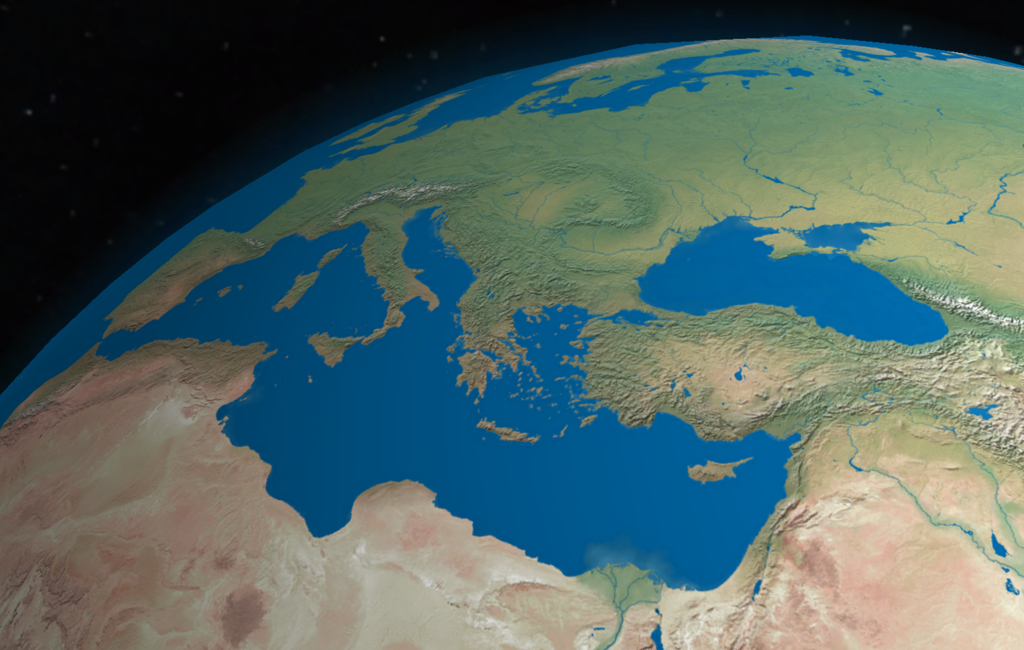
The Mediterranean region, at the crossroads of three continents, with Europe to the north, Western Asia to the east and North Africa to the south, holds significant historical, cultural and geopolitical importance. It is a region marked by diverse civilizations and shared challenges that extend beyond national borders. It is an area that displays concentrated and exacerbated versions of the major global imbalances (environmental, social and economic). The early 21st century saw a research renaissance well underway in countries across the Mediterranean. Investments in scientific infrastructure and workforce have ushered in a new era, comparable to the scientific achievements of the Umayyad and Abbasid Caliphates more than 1,000 years ago.
Scientists in the Mediterranean
still face substantial challenges
as they work to expand scientific capacity
and pursue cross-Mediterranean collaboration.
However, scientists in the Mediterranean still face substantial challenges as they work to expand scientific capacity and pursue cross-Mediterranean collaboration. The region, spanning 22 countries with a combined population of 480 million, is characterized by its rich diversity and shared challenges, including climate change, population growth, water scarcity and migration. These interconnected issues, compounded by social, economic and political factors, require collaborative efforts to devise and implement effective solutions. Recognizing this, Mediterranean governments are increasingly integrating science diplomacy into higher education and research institutions to involve their populations more deeply in science and technology.
A more coherent strategy for collaboration
in education and research is critical in either protecting
the status quo of a fragmented regional policy
or building new relationships.
Science diplomacy involves leveraging scientific cooperation to tackle global challenges and promote collaboration between nations. It is rooted in principles of mutual benefit and knowledge exchange, and aims to inform foreign policy decisions, facilitate international partnerships and improve relations and collaborations between countries. The shared nature of environmental and resource challenges in the Mediterranean region presents significant opportunities for establishing collaborative scientific policies between different countries of the Mediterranean Basin. The future of cooperative action lies in forming new partnerships and collaborations between civil society, businesses, governments and regional alliances. Such partnerships can provide the innovative leadership that our global population desperately needs. A more coherent strategy for collaboration in education and research is critical in either protecting the status quo of a fragmented regional policy or building new relationships.
The 2030 Agenda for Sustainable Development, launched by the United Nations in NYC, USA on 25-27 September 2015, aimed to end various forms of poverty worldwide and has energized Mediterranean countries to be politically and scientifically united in achieving the 17 Sustainable Development Goals (SDGs). The cooperative actions of Mediterranean governments involve interactions between politicians and scientists through conferences, workshops, agreements, knowledge and research result sharing, exchange visits and cross-cultural exchanges. This fosters the determined and innovative leadership that the Mediterranean population desperately needs. Today, all Mediterranean countries are embedding the SDGs into their national development plans. Parliaments and politicians ensure that the SDGs are a priority in governmental actions and scientific policies.
Significant portions of national budgets are allocated to projects supporting the SDGs, such as infrastructure for clean energy, education, healthcare and sustainable agriculture. Financial incentives are provided for businesses and communities to adopt sustainable practices, such as tax-free bills for green technologies and subsidies for sustainable farming methods. Universities and research institutes in the Mediterranean actively engage in joint conferences and summits focused on sustainable development, such as the United Nations General Assembly and the COP climate conferences. Politicians and governments facilitate partnerships between Mediterranean countries and collaboration with international organizations and NGOs to achieve the SDGs.
Politicians and governments are encouraging scientists to use public platforms to educate citizens about the importance of the SDGs and how they can contribute to achieving them. This includes talks, social media campaigns and visits by children and youth to universities. The European Union emphasizes the importance of robust data collection and monitoring frameworks. Eurostat, the EU’s statistical office, plays a critical role in tracking progress towards the SDGs, ensuring that data is disaggregated by geographic location, gender and other relevant factors to provide a comprehensive view of advancements and areas needing improvement.
Mediterranean countries also engage in international cooperation to address global challenges such as climate change, biodiversity loss and sustainable economic growth. This involves partnerships with UN agencies and participation in global initiatives like the UN’s Local2030 initiative, which supports the localization of the SDGs. The European Union budget, along with the NextGenerationEU recovery package, serves as a crucial financial tool for implementing the SDGs. These funds support various initiatives aimed at achieving sustainable development across the region.
Herein, the role of the Partnership for Research and Innovation in the Mediterranean Area (PRIMA) should be considered. PRIMA is a significant initiative aimed at addressing these challenges through collaborative research and innovation between Mediterranean countries. Emphasizing equality, long-term commitment and joint efforts in research and innovation, PRIMA aims to foster inclusive and sustainable development in the Mediterranean, particularly in agro-food and water systems. PRIMA’s impacts are wide-ranging, encompassing economic, social and environmental spheres. Through initiatives focused on increasing productivity, expanding market access and promoting political stability, PRIMA contributes to sustainable development and prosperity in the Mediterranean. By fostering cooperation and trust among participating countries, PRIMA lays the groundwork for resilience and long-term stability in the region.
Collaboration within the PRIMA participating states is crucial for advancing science diplomacy in the Mediterranean. By aligning research efforts, addressing societal needs and strengthening collaboration between EU Member States and Mediterranean countries, PRIMA promotes trust and inclusivity in the region. Furthermore, it supports the achievement of the SDGs and enhances cooperation among Mediterranean nations.
Universities and research institutions
play a central role in advancing science diplomacy
in the Mediterranean.
In conclusion, we can emphasize that universities and research institutions play a central role in advancing science diplomacy in the Mediterranean. Through research, collaboration and knowledge exchange, these institutions help tackle common challenges and foster cooperation among nations. Initiatives like PRIMA provide platforms for universities to engage in collaborative research and innovation, paving the way for sustainable development and prosperity in the Mediterranean. As the region faces its challenges, science diplomacy offers a route to unity and progress, fostering partnerships and promoting peace through knowledge and collaboration.
These collective efforts illustrate a comprehensive approach to integrating the SDGs into national, regional and local policies, ensuring that sustainable development remains a key priority across the Mediterranean region.
References
European Commission. The NextGenerationEU recovery plan, 2021.Retrieved from https://ec.europa.eu/info/strategy/recovery-plan-europe_en.
European Parliament. Report on the role of EU cohesion policy in implementing the Sustainable Development Goals, 2022. Retrieved from www.europarl.europa.eu/doceo/document/A-9-2022-0174_EN.html.
Eurostat. Eurostat’s role in tracking progress towards the SDGs, 2022. Retrieved from, https://ec.europa.eu/eurostat/web/sdi.
PRIMA. PRIMA – Partnership for Research and Innovation in the Mediterranean Area. Retrieved from http://prima-med.org/.
United Nations. Transforming our world: The 2030 Agenda for Sustainable Development, 2015. Retrieved from https://sdgs.un.org/2030agenda.
United Nations. Local and regional governments at the heart of the Global Agenda 2030. Retrieved from https://sdgs.un.org/partnerships/local-and-regional-governments-heart-global-agenda-2030.